An online learning experience for math teachers
Program details:
Who: The program is designed for current K-12 teachers (folks who teach elementary, middle, or high school) who are interested in stretching themselves mathematically and connecting the math that they teach with recent progress on interesting and important mathematical problems. Pre-service teachers and math education students are welcome. Teacher educators, math coaches, and those in related roles are also welcome join in.
Just to emphasize: this program is intended for interested math teachers, with no additional assumptions about prior knowledge or past experiences. I’ve taught most everything from fifth grade math on through the US high school curriculum. There are real and substantial connections between the math we teach students (adding fractions, finding areas and perimeters, applying the Pythagorean theorem) and math that is still being discovered and that is yet-to-be-discovered. Check out the problem sets from past years if you want to get a sense of the kind of work we’ll do. You will stretch yourself mathematically, but you can do this!
Teachers from around the world are welcome to participate. The scheduling for many of the Zoom sessions is constrained by availabilities of the majority of participants (from the US) and my availability (currently in Australia). But even if you can’t come to any of the Zooms, you can still get something out of the experience through the self-paced work, by interacting with other participants through our message board, and by watching recordings of sessions. The book and my presentations will be in English. You are welcome to participate with whatever level of skill with English you currently have, and there are no speaking/writing requirements.
If you decide to participate, you might encourage a colleague or two to sign up as well. Maybe a colleague at your school or in your district, or maybe a math teacher friend you know from online. While you will meet some new people during the program, it can be fun/motivating/impactful to discuss ideas and solve problems with people you already know and work with. I provide additional support for folks who organize this kind of group participation for colleagues at their school or area.
The program organizer is Justin Lanier. I’m a mathematician at the University of Sydney with an ongoing interest in building bridges between the K-12 and research math worlds. Before earning my PhD in math, I taught middle and high school math for ten years. You might know me as one of the authors of Math Munch or through my participation in various MTBoS activities, events, and initiatives.
I reserve the right to limit who participates in the program in order to best serve the target audience of K-12 math teachers and to ensure a welcoming and supportive learning environment.
What: “21st century mathematics” is designed to be flexible and enriching online learning experience.
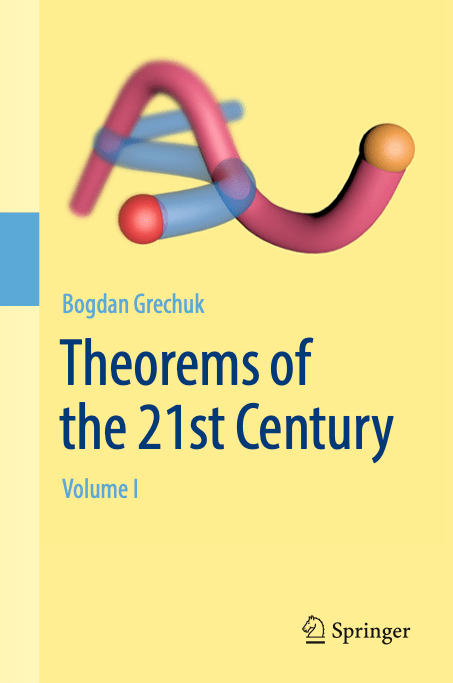
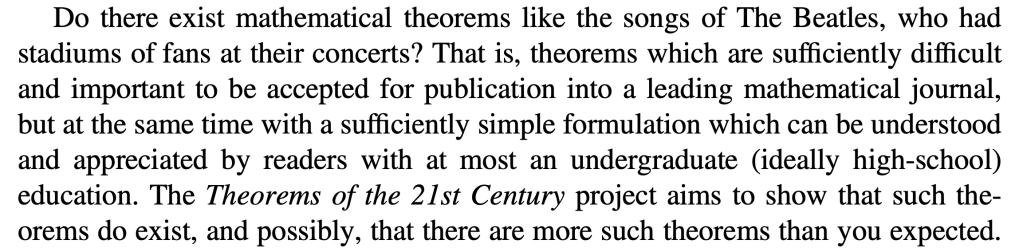
The main activity is digging into selections from Bogdan Grechuk’s book Theorems of the 21st Century. The book contains many short chapters that introduce important math breakthroughs that were published from 2001 to 2010. Each intro is 3 to 4 pages long and is written in an accessible way, showing how new math theorems grow out of familiar elementary, middle, and high school mathematics. Here is the book’s preface, table of contents, and two sample chapters. I will provide participants with a pdf copy of the book to use during the program.
We will focus on two of these math breakthroughs, each one for two weeks. You’ll be encouraged to read the chapters about these breakthroughs. I will share a collection of problems related to the math of the breakthroughs, problems that start at the elementary, middle, and high school level and build toward the ideas of the breakthrough with problems that are “low threshold, high ceiling”. I’ll provide some prompts for you to reflect on what you read and on your problem solving experience.
I’ll lead some Zoom sessions each week. Some sessions will be focused on the big picture of math research: what it is, how it gets done, and who does it. Other sessions will be focused on the highlighted math breakthrough, where I’ll share some insights and context and there will also be time to work on problems together in breakout rooms. And some sessions we will have guest speakers and Q&A sessions with the mathematicians who made the breakthroughs or who work on closely related math.
Participants are encouraged to interact with each other on the program’s message board and through problems solving sessions they organize.
I will also have some Zoom “office hours” where I’ll be available to chat with participants about whatever they’re interested in.
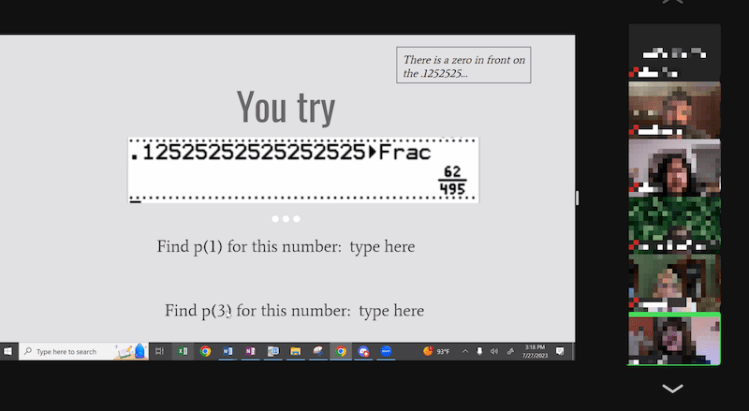

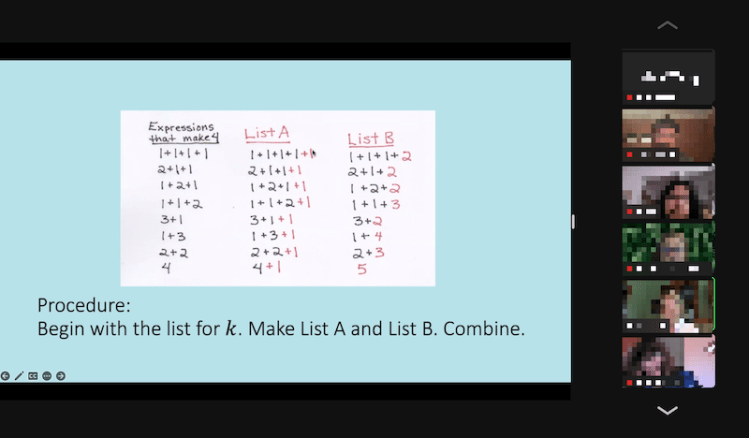
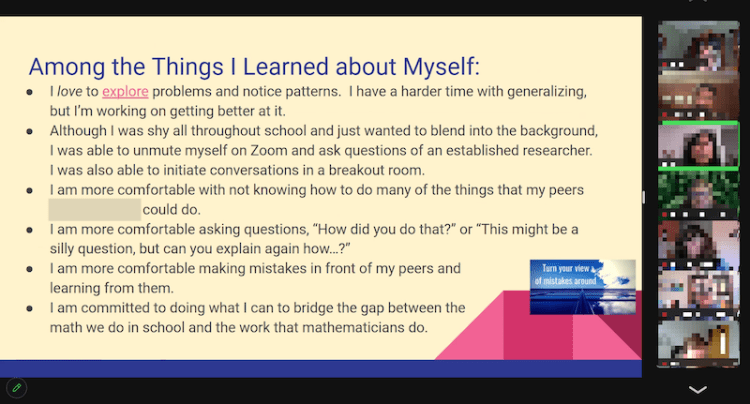
Presentations by participants (2023)
Shortly after our four weeks together, I’ll host a final Zoom sessions where some participants will give a short presentations about some aspect of the work they’ve done.
This is all designed to meet you where you are, to help you to find and pursue your own interests and goals, and to be flexible. If you have a schedule conflict and can’t make a Zoom meeting or two, or any of them, you can still get a lot out of the experience! The same goes if you are not available some weeks because of other commitments.
When: Many of the program activities you can do on your own and on your own schedule. Zoom sessions happen each weekday during the program. Many are from 5-6pm Eastern time, given a number of constraints. Additional sessions to supplement these will be scheduled after I poll registrants to figure out good time slots.
Any amount of participation is great! If you sign up and then come to just one session—maybe a Q&A with a mathematician—you might get some energy and ideas from it. If you can spend two hours each week in some combination of activities (or fewer weeks but with more hours), I think you’ll get something substantial out of the program. As one participant from last year reflected: “Make sure you have a few hours a week you can dedicate to the activities – you get out what you put in.” Getting the full effect of the program would probably look more like four hours a week, between working on your own, participating in Zoom sessions, and interacting with other participants. Some past participants really dove in and spent more time on the various activities and felt they got a lot out of it!
Also know that if you sign up and then don’t end up participating that much or at all, that is okay; it doesn’t put any extra burden on me or other participants, and it doesn’t mean that someone else isn’t getting a chance to participate. So there is no risk in signing up.
A last important aspect of “when” is that I plan to continue running this program each year for many years to come. So you can plan to come back for more great math—some years maybe just a little, or not at all, and some years more. Build on success, stretch yourself some more, greet some familiar faces and meet some new ones.
Why: There are many reasons you might decide to participate. Here are a few:
– Grow as a mathematician, for your own enrichment and for the benefit of your students.
– Get re-energized and re-enthused about math—a spa or retreat for your math-self.
– Learn about connections between familiar math concepts and cutting-edge research.
– Revisit K-12 or college math you haven’t seen in a while, in a new interesting context.
– Connect with other teachers who are also intrigued by engaging with math research.
I have often found that by stretching myself mathematically, I can better help my students to stretch themselves mathematically. It opens me up, builds my confidence that I “can”, and reassures me that it’s okay to be confused, or to have partial knowledge, or to get stuck. There is also the excitement of having “aha” moments and understanding math that before seemed far out of reach. This is how I want my students to experience mathematics, and experiencing it that way myself helps me to pass it along. Also, learning about new math is exciting and a lot of fun!
Regarding teacher licensure credit hours or CEUs: “21st century mathematics” is not currently registered anywhere as a provider for certification hours. If your school/district/state just requires a certificate of participation that includes how many hours you worked for the program, I am happy to provide you with one; you’ll just need to submit a planning form at the start of the program and a summary form of your participation at the end of the program. If your situation requires more steps than just a certificate of participation, there will be a form about this early on that you can submit to me and I will help you out as I’m able.
Regarding stipends: The funding model of the program is that I make the program and you participate in the program and we don’t charge each other. The work is just worth doing. If I charged people for the program, I think people would think that made sense. If I offered stipends for the program, I think people would think that made sense, too. So I would rather split the difference and keep it no-cost and just nudge participants toward a small “pay it forward” contribution. All that said, if you school or district or other organization has funds available for you to participate in or purchase professional development, I think it would be great for them to provide you financial support to help you to participate more actively in the program and with more focus, giving you time that you might otherwise spend doing extra work to supplement your income. I’m glad to support you in accessing funds that are available to you. To keep things on the up and up, I would ask you to submit planning and summary forms for your participation, like with the CEUs above. Email me if this is a possibility for you and you would like my help in pursuing it. Once this happens successfully a few times, in the future I’ll post some stories and suggestions from folks who made it work for them.
How much: There is no fee to participate! I will encourage participants to consider making a $25 donation to one of several worthy initiatives that are helping to make the math world more accessible and supportive. Your donation will make an impact, it’s a great way to “pay forward” an enriching math experience—and of course putting some skin in the game is always a good way to keep focus and commitment. (:
Here are a few great initiatives for you to consider donating to!
African Institute for Mathematical Sciences (AIMS) – donate
Bridge to Enter Advanced Mathematics (BEAM) – donate
Enhancing Diversity in Graduate Education (EDGE) – donate
Julia Robinson Mathematics Festival (JRMF) – donate
Latinx and Hispanics in the Mathematical Sciences (Lathisms) – donate
I also provide a contribution option where you can help me cover the small cost it takes to run the program, and once they’re covered I’ll donate the rest to the above organizations.
Norms and feedback
A couple of important norms to keep in mind throughout the program, which you agree to follow when you register:
1) We will be considerate and respectful towards other participants.
2) We will be patient and generous towards ourselves and others, recognizing we are all on our own math journeys.
3) We are always welcome to ask for help, and we are also always welcome to choose to wrestle further with math on our own.
If you find that you are having a negative experience in the program or have a negative interaction with another participant that needs to be addressed, please reach out to me. You can do this by email or through this anonymous feedback form.
 Justin Lanier