An online learning experience for math teachers
Registration for the 2025 program has closed. If you would like to be notified about future editions of the program, just fill out this form.
If you have registered for the program but have not received emails from me, please reach out: justin.lanier@gmail.com.
Almost all of the math that we teach to our students is hundreds if not thousands of years old. Even so, new math is being figured out every day. The goal of this learning experience is to encounter some recent math discoveries, learn about and meet some of the people who made them, and get some insight into the process of mathematical research. Doing this can shape our own understanding of math and impact how we share math with our students in our classrooms. It can also be a lot of fun!
To understand the program, the best place to start is with the program quick facts down below on this page. After that, if you’d like all the details about the program, here are the long description and the program guidebook. If you prefer for information to come “just in time”, you can go ahead and register and you’ll get details when you need them, starting mid-June.
Program quick facts:
Who: A group of elementary, middle, and high school teachers who teach math (maybe you!) and led by Justin Lanier. Others involved in math education are also welcome to participate. We have participants from all around the world.
When: The four weeks from July 7 to August 1, 2025. Many of the “live” events will happen daily on weekdays on Zoom from 5-6pm Eastern time. Click here to convert this time into your local time zone, and here is a draft schedule of program events. An active participant might attend just a handful of those 20 sessions, or even none at all. I mention these dates and times now as a kind of “save the date”, to help you with your own schedule planning. Additional Zoom session will be sprinkled at other times once registrants give timing input in mid-June, so as to allow greater participation across schedules and time zones. Sessions with presentations will be recorded and you’ll be able to access these recordings on-demand. The “live” sessions are a valuable component of the program, but a lot of participant activity actually happens asynchronously and flexibly—even if you never come to a scheduled Zoom session, you can still be an active and engaged program participant.
What: This is a chance to learn about some recent math breakthroughs and to connect that math to your classroom practice by reading, problem solving, reflecting, and discussing. There’s lots to try: reading selections from a cool book, working on problems together, interacting with other teachers on Zoom and through a message board, and meeting some mathematicians who have made these breakthroughs and are continuing to build upon them. The main flow of the program all happens online, but some participants meet in person to work and chat locally. Participation is flexible and customizable.
The breakthroughs we’ll learn about this year are answers to some simple questions about shapes and numbers. “What is the most efficient way to enclose two volumes in space?” and “Which Fibonacci numbers are perfect powers?”

We will have the chance to meet a number of mathematicians, hear about their work, and have time to discuss and do Q&A with them. Learn a bit more about our visitors on this page.

Why: To grow as mathematicians, both for our own enjoyment and enrichment, as well as for the benefit of our students. And many other reasons, too! For details regarding teacher licensure credit hours or CEUs, as well as stipend possibilities, see the detailed “Why” section in the long description.
How much: It’s free to participate! I encourage participants to make an optional small donation to one of several great math education causes; this is a way “pay forward” an enriching math experience and also a way to be a bit more invested in your participation in the program.
Sign up: Registration for 2025 is now closed.
Questions? Please reach out! justin.lanier@gmail.com
As mentioned above, you can learn more about the program in the long description and in the program guidebook.
This program has run twice before. You can browse materials from those programs at the following links.
2024: website, folder
2023: website, folder

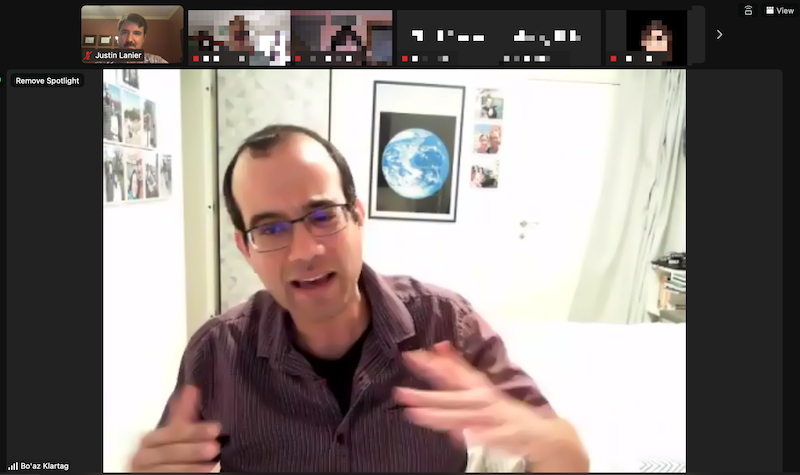
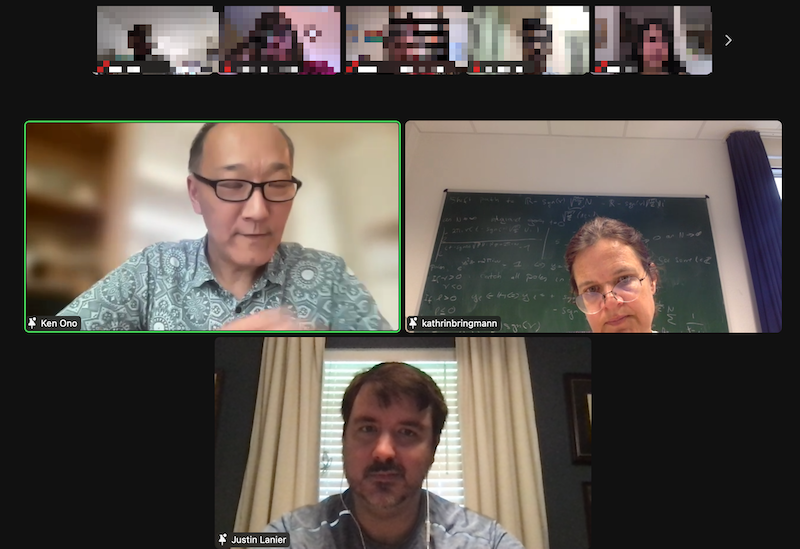
Q&A sessions with mathematicians Ernie Croot,
Bo’az Klartag, Kathrin Bringmann, and Ken Ono (2023)
Some quotes from past participants:
“I have a much better understanding of what mathematicians do and what constitutes the subject of mathematics.“
“Reading the book was both accessible and challenging. I enjoyed it very much. I wouldn’t have thought the book was “for me” without the class and now I also think it is for my students!“
“Discussing and collaborating with other participants helped me see new perspectives on the problems. So many other participants had so many great ideas and extensions on the problems, and it opened my eyes to how I can expand on problems like these and how I can continue to discover things in math.“
“The program was so well organized!!! You explained the structure in advance. The materials were readily available. The reminders you sent about the Zoom meetings were particularly helpful. The problem sets were wonderful. The problems were interesting and didn’t assume a lot of background knowledge. The level of difficulty seemed good for high school and middle school teachers.“
“Working on the problem sets encouraged my curiosity and creativity in problem solving. Attending the presentation sessions allowed me to understand the process that researchers go through and also gave me the opportunity to meet other participants, discuss the problems, and ask questions.“
“The Q&A sessions were really exciting. We learned some things about [the mathematicians’] experiences as students, professional activities, use of technology, and glimpses of what they are studying. They talked about how their work has changed as they mature and how they approach problems. It was fascinating.“
 Justin Lanier