An online learning experience for math teachers
The 2024 edition of program has finished up. The program runs each year in July. If you’d like to get notified when registration opens for the program in 2025, you can fill out this short interest form.
I invite you to explore some of the materials from the 2024 and 2023 programs.
Almost all of the math that we teach to our students is hundreds if not thousands of years old. Even so, new math is being figured out every day. The goal of this learning experience is to encounter some recent math discoveries, learn about and meet some of the people who made them, and get some insight into the process of mathematical research. Doing this can shape our own understanding of math and impact how we share math with our students in our classrooms. It can also be a lot of fun!
Quick facts (with more details down below):
Who: A group of elementary, middle, and high school teachers who teach math (maybe you!) and led by Justin Lanier.
What: This is a chance to learn about some recent math breakthroughs and to connect those breakthroughs to your classroom practice by reading, problem solving, reflecting, and discussing. You’ll read selections from a cool book, work on problems together, interact with other teachers on Zoom and through a message board, and meet some mathematicians. This all happens online and participation is flexible. The format will be similar to last year’s version of the program, but we will focus on different sections from the book and work on new problem sets. So newcomers and past participants are all very much welcome!
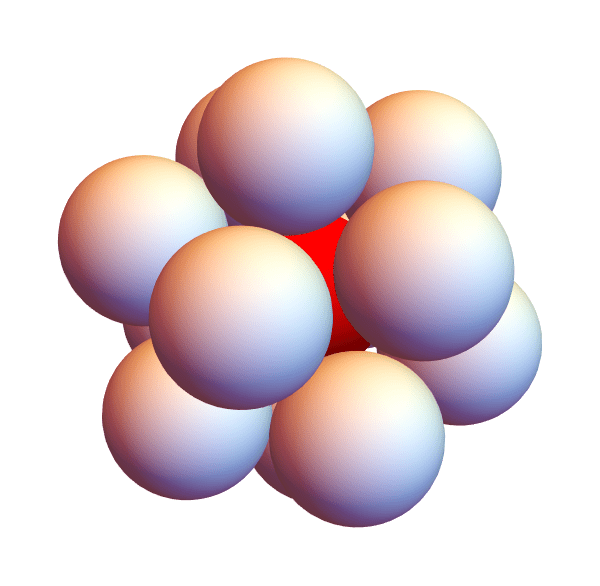
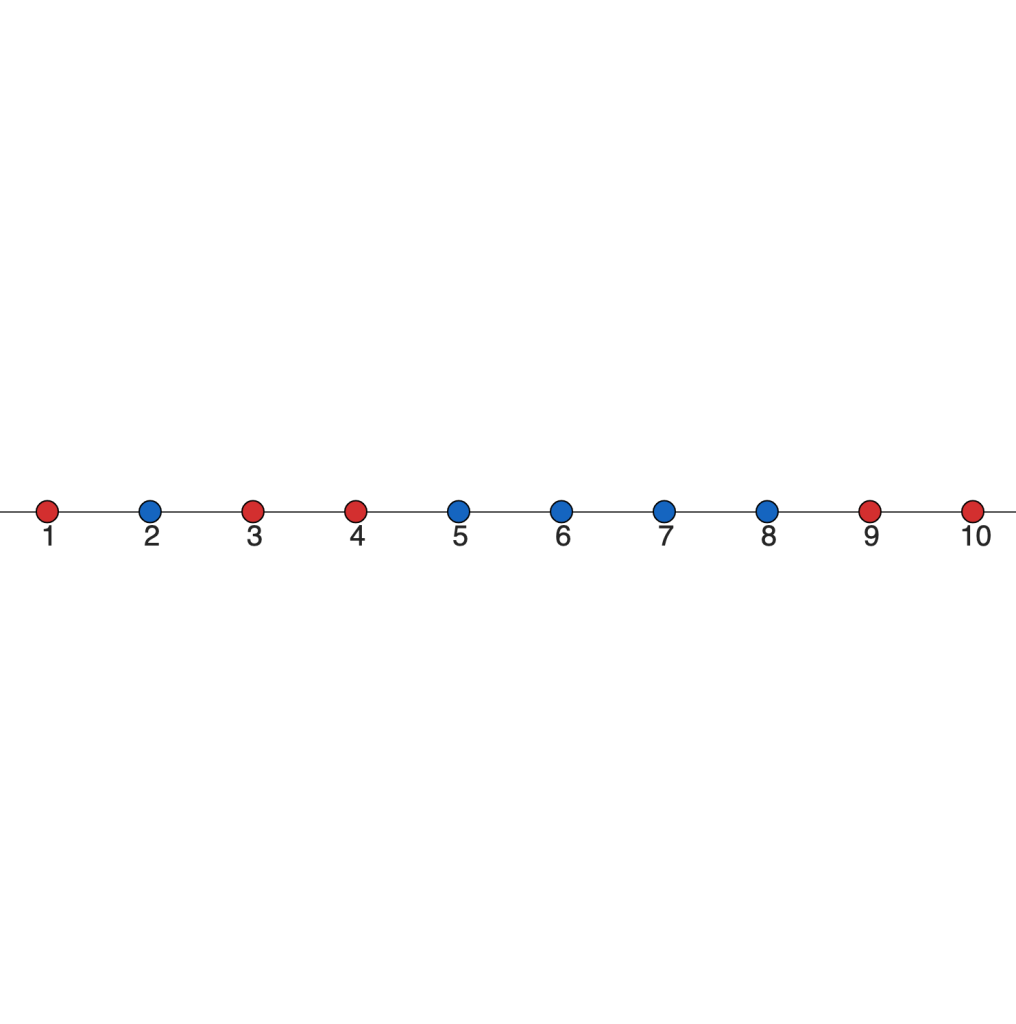
This year the breakthrough results we will focus on all have a theme: packing problems. “How many of these can fit into this?” Together it’s a great mix of arithmetic, algebra, and geometry, and some new math ideas as well.
We will have the chance to meet a number of mathematicians, hear about their work, and have time to discuss and do Q&A with them.
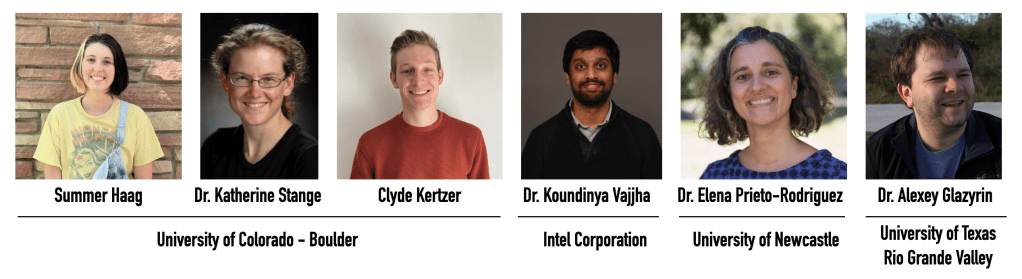
You can read some about their work here, here, here, and here!
When: The four weeks from June 10 to July 5, 2024. The self-paced activities happen on your own schedule. There are several “live” Zoom events each week, to be scheduled according to everyone’s availability. If you aren’t available for some of the weeks or some of the activities—or even can’t make the live events at all—you can still participate and get something out of the program.
Why: To grow as mathematicians, both for our own enjoyment and enrichment, as well as for the benefit of our students. And many other reasons, too!
For details regarding teacher licensure credit hours or CEUs, see the detailed “Why” section down below.
How much: It’s free to participate! I encourage participants to make an optional small donation to one of several great math education causes.
Sign up: Registration is now closed.
Questions? Please reach out! justin.lanier@gmail.com
There are more details about the program below. And there are even more details in the program guidebook.
I invite you to explore some of the materials from the 2024 and 2023 programs.

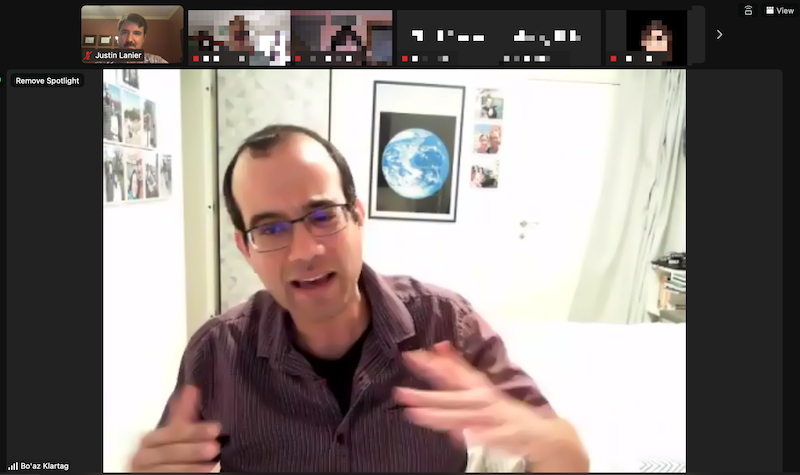
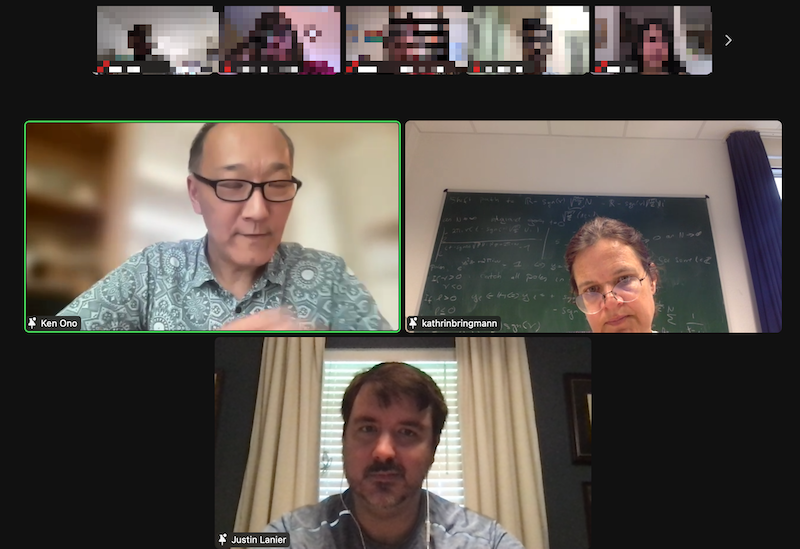
Q&A sessions with mathematicians Ernie Croot, Bo’az Klartag, Kathrin Bringmann, and Ken Ono (2023)
Some quotes from last year’s participants:
“I have a much better understanding of what mathematicians do and what constitutes the subject of mathematics.“
“Reading the book was both accessible and challenging. I enjoyed it very much. I wouldn’t have thought the book was “for me” without the class and now I also think it is for my students!“
“Discussing and collaborating with other participants helped me see new perspectives on the problems. So many other participants had so many great ideas and extensions on the problems, and it opened my eyes to how I can expand on problems like these and how I can continue to discover things in math.“
“The program was so well organized!!! You explained the structure in advance. The materials were readily available. The reminders you sent about the Zoom meetings were particularly helpful. The problem sets were wonderful. The problems were interesting and didn’t assume a lot of background knowledge. The level of difficulty seemed good for high school and middle school teachers.“
“Working on the problem sets encouraged my curiosity and creativity in problem solving. Attending the presentation sessions allowed me to understand the process that researchers go through and also gave me the opportunity to meet other participants, discuss the problems, and ask questions.“
“The Q&A sessions were really exciting. We learned some things about [the mathematicians’] experiences as students, professional activities, use of technology, and glimpses of what they are studying. They talked about how their work has changed as they mature and how they approach problems. It was fascinating.“
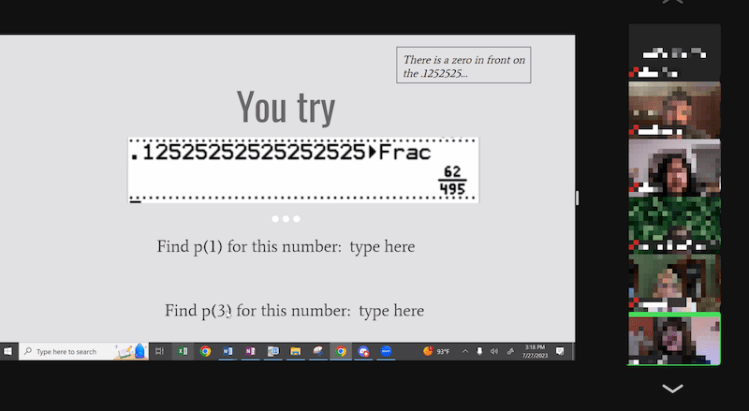

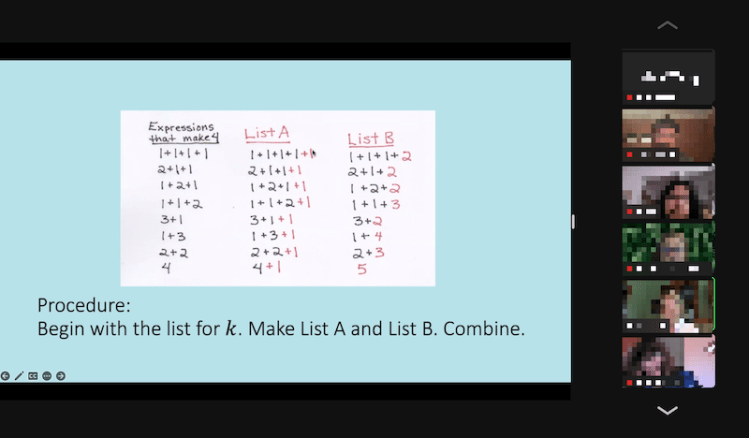
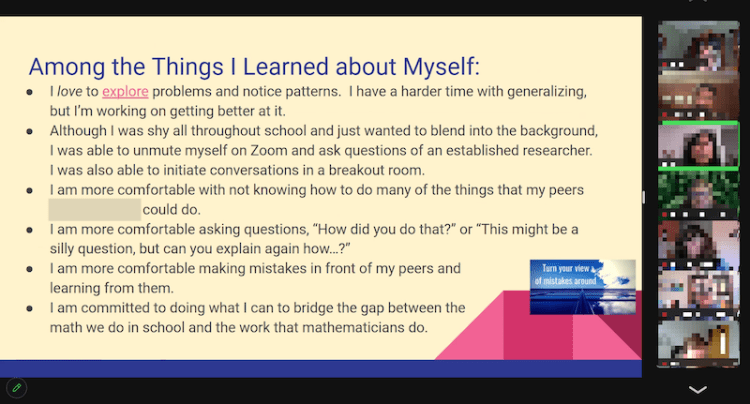
Presentations by participants (2023)
Program details:
Who: The program is designed for current K-12 teachers (folks who teach elementary, middle, or high school) who are interested in stretching themselves mathematically and connecting the math that they teach with recent progress on interesting and important mathematical problems. Pre-service teachers and math education students are welcome. Teacher educators, math coaches, and those in related roles are also welcome join in.
Just to emphasize: this program is intended for interested math teachers, with no additional assumptions about prior knowledge or past experiences. I’ve taught most everything from fifth grade math on through the US high school curriculum. There are real and substantial connections between the math we teach students (adding fractions, finding areas and perimeters, applying the Pythagorean theorem) and math that is still being discovered and that is yet-to-be-discovered. Check out the problem sets from 2023 if you want to get a sense of the kind of work we’ll do.
Teachers from around the world are welcome to participate. The Zoom sessions are scheduled according to the availabilities of participants (majority from the US) and my availability (in Australia). But even if you can’t come to any of the Zooms, you can still get something out of the experience through the self-paced work and by interacting with other participants through our message board. The book and my presentations will be in English. You are welcome to participate with whatever level of skill with English you currently have, and there are no speaking/writing requirements.
If you decide to participate, you might encourage a colleague or two to sign up as well. Maybe a colleague at your school or in your district, or maybe a math teacher friend you know from online. While you will meet some new people during the program, it can be fun/motivating/impactful to discuss ideas and solve problems with people you already know and work with.
The program organizer is Justin Lanier. I’m a mathematician at the University of Sydney with an ongoing interest in building bridges between the K-12 and research math worlds. Before earning my PhD in math, I taught middle and high school math for ten years. You might know me as one of the authors of Math Munch.
I reserve the right to limit who participates in the program in order to best serve the target audience of K-12 math teachers and to ensure a welcoming and supportive learning environment.
What: “21st century mathematics” is designed to be flexible and enriching online learning experience.
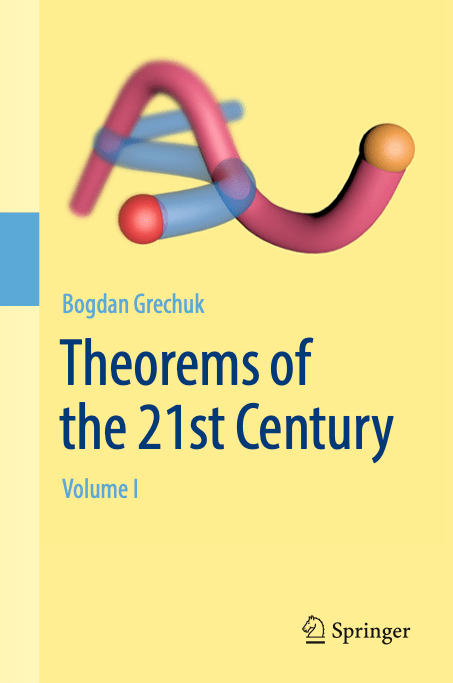
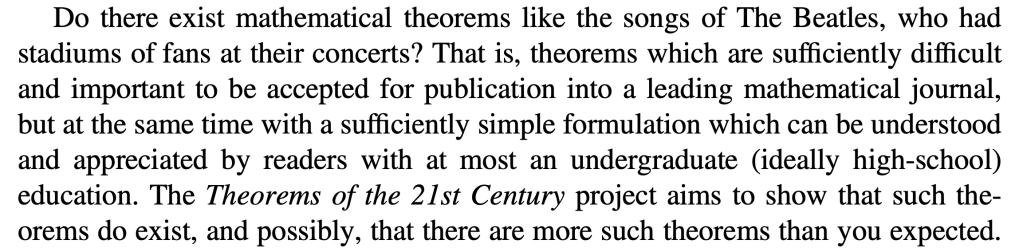
The main activity is digging into selections from Bogdan Grechuk’s book Theorems of the 21st Century. The book contains many short chapters that introduce important math breakthroughs that were published from 2001 to 2010. Each intro is 3 to 4 pages long and is written in an accessible way, showing how new math theorems grow out of familiar elementary, middle, and high school mathematics. Here is the book’s preface, table of contents, and two sample chapters. I will provide participants with a pdf copy of the book to use during the program.
Each week we will focus on one of these math breakthroughs. You’ll be encouraged to read the chapter about it. I will share a collection of problems related to the math of the breakthrough, problems that start at the elementary, middle, and high school level and build toward the ideas of the breakthrough with problems that are “low threshold, high ceiling”. I’ll provide some prompts for you to reflect on what you read and on your problem solving experience.
I’ll lead three Zoom sessions each week. One session will be focused on the big picture of math research: what it is, how it gets done, and who does it. Another session will be focused on the math breakthrough for the week, where I’ll share some insights and context and there will also be time to work on problems together in breakout rooms. And at one session we will have guest speakers and Q&A sessions with the mathematicians who made the breakthroughs or who work on closely related math.
I will also have some Zoom “office hours” where I’ll be available to chat with participants about whatever they’re interested in.
Participants are encouraged to interact with each other on the program’s message board and through problems solving sessions they organize.
In the last week, participants can choose to give a short presentation about some aspect of the work they’ve done.
This is all designed to meet you where you are, to help you to find and pursue your own interests and goals, and to be flexible. If you have a schedule conflict and can’t make a Zoom meeting or two, or any of them, you can still get a lot out of the experience!
When: Many of the program activities you can do on your own and on your own schedule. I am planning for the Zoom sessions each week to happen Monday–Wednesday–Friday, probably in the afternoon in US time zones. I will send out a poll to registrants to figure out good time slots.
If you can spend two hours each week in some combination of activities, I think you’ll get something out of the program. As one participant from last year reflected: “Make sure you have a few hours a week you can dedicate to the activities – you get out what you put in.” Getting the full effect of the program would probably look more like four hours a week, between working on your own, participating in Zoom sessions, and interacting with other participants. Last year some participants really dove in and spent more time on the various activities and felt they got a lot out of it!
Also know that if you sign up and then don’t end up participating that much or at all, that is okay; it doesn’t put any extra burden on me or other participants, and it doesn’t mean that someone else isn’t getting a chance to participate. So there is no risk in signing up.
Why: There are many reasons you might decide to participate. Here are a few:
– Grow as a mathematician in an enjoyable and enriching way and for the benefit of your students
– Learn about connections between familiar math concepts and cutting-edge research
– Revisit K-12 or college math you haven’t seen in a while, in a new interesting context
– Connect with other teachers who are also intrigued by engaging with math research
I have often found that by stretching myself mathematically, I can better help my students to stretch themselves mathematically. It opens me up, builds my confidence that I “can”, and reassures me that it’s okay to be confused, or to have partial knowledge, or to get stuck. There is also the excitement of having “aha” moments and understanding math that before seemed far out of reach. This is how I want my students to experience mathematics, and experiencing it that way myself helps me to pass it along. Also, learning about new math is exciting and a lot of fun!
Regarding teacher licensure credit hours or CEUs: “21st century mathematics” is not currently registered anywhere as a provider for certification hours. If your school/district/state just requires a certificate of participation that includes how many hours you worked for the program, I am happy to provide you with one; you’ll just need to submit a planning form at the start of the program and a summary form of your participation at the end of the program. If your situation requires more steps than just a certificate of participation, please email me about this early on and I will help as I’m able.
How much: There is no fee to participate! I will encourage participants to consider making a $25 donation to one of several worthy initiatives that are helping to make the math research world a more equitable and supportive endeavor. Your donation will make an impact—and putting some skin in the game is always a good way to keep focus and commitment. (:
Here are a few great initiatives for you to consider donating to!
African Institute for Mathematical Sciences (AIMS) – donate
Bridge to Enter Advanced Mathematics (BEAM) – donate
Enhancing Diversity in Graduate Education (EDGE) – donate
Julia Robinson Mathematics Festival (JRMF) – donate
Latinx and Hispanics in the Mathematical Sciences (Lathisms) – donate
Mathematically Gifted and Black (MGB) – donate (click “Donate” and choose MGB from the dropdown menu)
Sign up: Registration is now closed.
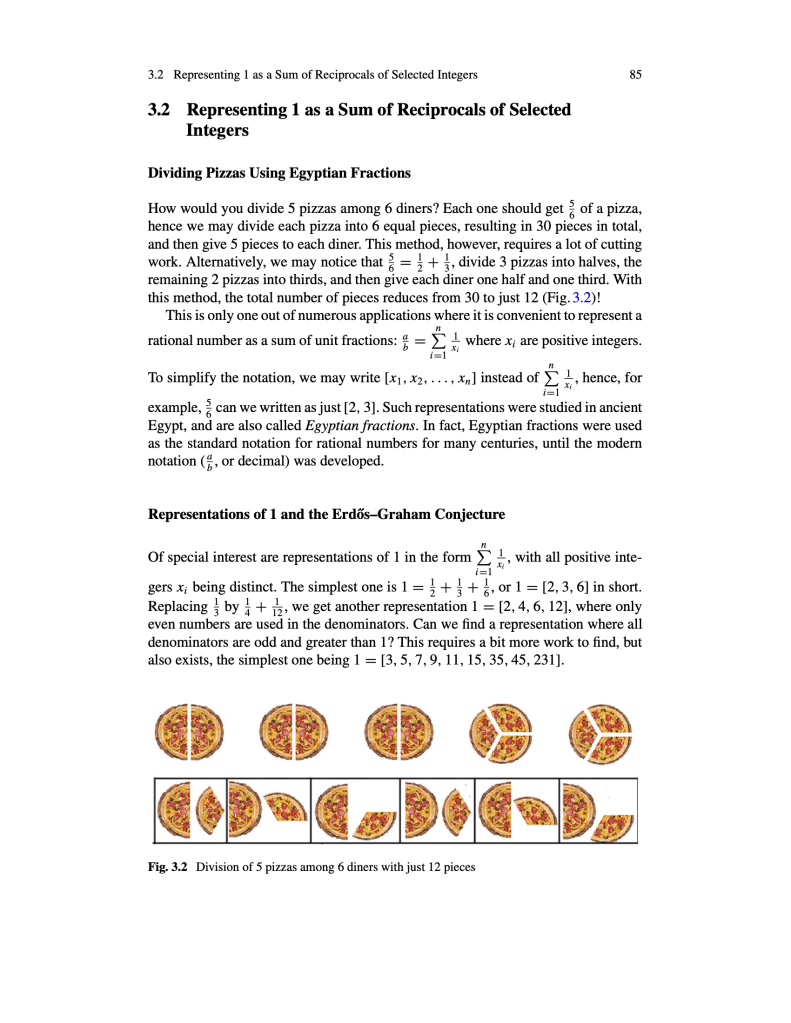
Sample page from Theorems of the 21st Century:
 Justin Lanier